Wednesday, November 3, 2021

Asli Naqli - The faceoff with life

Hrishida - the creator of happy movies


To say that Hrishikesh Mukherjee’s movies are both entertaining and charming, is an understatement. He can combine the quintessence of home, feel of a city, values of family, romance of two individuals and a quiet suspense all thrown in a wonderful plot. He has the masterly talent of showing  thought, charm and joie de vivre to help us think and live through his movies. Like a companion for life, Hrishida’s movies stay with us always.


Asli Naqli 


Asli Naqli made in 1962 was a memorable movie starring Dev Anand and Sadhna. In the movie, Anand played by Dev Anand is a rich man’s grandson. Unlike a rich, pompous baron he is a man who thinks and contemplates on his existence, questioning his everyday life and of the golden cage he lives in. Lying on a velvety chaise with a shining glass of whisky from a ludicrous bar of his drawing room which has his photo on a silver frame, Anand is dazzled but is aware of his hollow life.

 This cognizant and discerning nature of Anand provokes a series of arguments with his grandpa in the following days with regard to a marriage deal for better business and managing the vast property. Anand runs away from home. 


Mansion vs Mohalla

He ends up meeting Mohan who takes him to his home which is in an impoverished locality. Mohan’s sister and friends welcome him with open arms and in their limited means they share their home. The stark difference of not just the status in living and conditions of Anand's past and his new residence is apparent but also the independent, carefree spirit of Mohan’s family and neighbors is juxtaposed with Anand’s overbearing, withdrawn Grandpa, dry with money and rank only. 


The romance

Anand soon meets Renu and the innocence of the two good humans bring them closer to each other. Renu’s mother is unaware of her husband’s death and is made to believe so because Renu believes she doesn't have the mental capacity to bear it. When Anand’s grandfather learns of this, he uses it to blackmail Renu into breaking off their relationship. Sinister scheme but still innocent because it's a Hrishida movie after all!


No muscle men or cabaret dances to fool the villains here. Hrishida uses intrinsic human values to show good over hollowness. Renu’s mother displays courage and tolerance on hearing the reality of her husband and conquers Anand’s father’s evil plan. 

Happily Anands after!


Leaving on a musical note


The song ‘tujhe jeevan ki dor se’ is an everlasting song and always memorable. Every movie of Hrishida has atleast two songs which are beautifully rendered. The music, setting, homely scenes and unpretentious acting speak of his simplistic vision of life and cinema. That's why Asli Naqli remains a treasure to watch and rewatch.


Wednesday, October 16, 2019

Bahurani 1989


I saw Bahurani (inspite of seeing it multiple times before) after watching the Rendezvous with Simi episode featuring actress Rekha. Its a pretty predictable story but of course enriched by the legendary actress' performance and a couple more amazing classic actors.


  Rekha and Sridevi are among the fabulous club of fine actresses who have held up so many movies singularly on their shoulders.


Amit played by Rakesh Roshan is a modern city man who detests villagers and village life. When his comically dominating father played by the delightful Utpal Dutt, forces him to marry the village girl Madhuri, played by Rekha,he starts finding ways and means to break off the marriage. On getting a perfect excuse, he storms off the mandap without seeing her face.

Carrying the weight of this insult, Rekha grooms herself and becomes his secretary. If Utpal Dutt wasn't enough for the comic tones, we have the unforgettable Deven Verma who adds only his special brand of humor.

After  a lot of hide and seek, Amit and Madhuri fall in love. The ending is ofcourse a moral lesson in Indian marriage, the meaning of wedding vows and the continuous chasing spirit of an injured Indian wife!


 A scene from the movie where Madhuri becomes Amit's secretary.


Director - Manik Chatterjee

Monday, October 9, 2017

Manzil 1960

I like Dev Anand for his smile and his unique persona. He brings that boyishness to the screen without much effort. And Manzil isn't untouched by it.


A young boy who has returned to his hometown in Shimla from vilayat is demanded by his rich dad to continue the family business. But the dreamy Raj( Dev Anand) is interested in music. The only one who understands him is Pushpa (Nutan). This leads to constant tiffs with his father and ultimately he goes away to Bombay.

He slowly finds success with helpful friends like Mehmood and a prostitute who tries to make advances on him. Pushpa misunderstands him and takes decisions that significantly decides the fate of the two.


I felt the first half was too slow with unnecessary romantic scenes and the only saving grace are the songs. S.D Burman once again weaves magic with his lovely melodies. Director Mandi Burman has brought a lot of lightness to an otherwise heavy,sad and tension filled story.


Watch it for the ever boyish and endearing  performance of Dev Anand and some great acting by Mehmood too.


Wednesday, April 12, 2017

Mere Mehboob 1963

If you love shaayari and old Hindi cinema, then you will appreciate Mere Mehboob, the 1963 blockbuster movie. With such giants of the golden era of Bollywood,Rajendra Kumar and Sadhna, this beautiful lyrical movie will capture every nostalgic fancy.


Dripping in poetry, beautiful costumes and the old Lucknowi style of living, Mere Mehboob is a like watching a lovely scenery on your vacation. Inspite of this visual fancy the movie is not just a musical or a moving sonnet. With a strong script, some amazing performances and dependable supporting cast of Ashok Kumar and Johnie Walker, Mere Mehboob will not let you budge or look at your phone ,if I should speak for my generation.


Set in the famed Aligarh University romance blooms in a  innocent way between Anwar and Husna, Kumar and Sadhna respectively. The kind of romance which is veiled and shy. The popular song Mere Mehoob sets the tone for the movie. The story moves to Lucknow where Husna is shown as Nawab Akhtar's sister ,who is extremely proud of his lineage and khaandaan.

 Aligarh University


 This is the thing about old style movies especially set in Lucknow, where the nawabi grace and conduct is so neatly shown without being over the top and being obvious about it. The glamour is subtle and comely.

Nawab Akhtar is also secretly in love with Najma, Anwar's sister. Najma,who is a dancer is played by Nimmi. Though he isn't ashamed of being in love with her or rebukes her profession , he is conscious of the society and thinks it against his refinement to marry her and make her begum of his khaandaani makaan. And a beautiful one at that!


Without any overly emotional dialogues and the obvious shaayari, the movie glides beautifully through showing every character's role in this story of sacrifice, family bond, prestige and love.

 Anwar with his sister


The nazaakat between the lovers


Watch for the Lucknowi andaz,the charming Sadhna or just some classic brilliance.

Old time Lucknow

Director - H.S. Rawail
Music - Naushad

Monday, February 29, 2016

Anupama 1966

Why hasn't Anupama been in the list of women-powered movies? Even though Sharmila doesn't have much dialogue delivery I felt she conveys more than Dharmendra (very strong on his own too though). No long eyelash fluttering, no twisting of sari pallu and no coy smile. Very few Hindi movies make you understand the protagonist's feelings in the right way,instead of sympathy or anger. Anupama agrees with you in the right way.


Anupama, a story of an introvert girl mostly ignored by her father and finding herself in the world. Joined by a host of emminent actors such as Dharmendra,Shashikala, David Abraham, Deven Verma etc, the movie is a discovery of relationships and of self.

Watch it for some finespun performances by Sharmila,Dharmendra and Tarun Bose as her father.


Thursday, February 11, 2016

Griha Pravesh

Extra marital affairs in movies are shown with dramatic effects. A weeping wife, hysterical family members,moral value discourse and the unmissable packing of suitcase despite the wife wearing gazillion sarees and jewellery.


In Griha Pravesh ,direcetd by Basu Bhattacharya, I was looking for similar things and was happily shocked. The husband Amar is played by Sanjeev Kumar and his better half as Mansi by Sharmila Tagore. He goes astray with Sapna (Sarika).

I saw the movie some days ago and yet it lingers in my mind like an amazing dessert. All three actors did a fantastic job. Sapna was not seductive with any questionable hemlines and sparkling lipstick. In fact she looked tomboyish with her striped vests and de-glam pants. Amar's role seems to be concentrated on two aspects - his own curiosity as to why Sapna thinks beyond her age and second is, just the basic physical need of sex. Yet there are no sleazy scenes and thankfully no perfume-lingered-shirts to start a 'Who,what,why' exhibition.The attraction was 'mature' if not morally right.


At the same time,Mansi is not dumb or a doormat. In a brief intimate scene(which is at the start of the movie,thus surprising me even more) she depicts a a confident woman who knows her desires.


Mansi is practical yet a dreamer. She wishes of her own home while they manage in a dilapidated,paint peeled,rented house.She has witty replies to their state yet is vulnerable. On knowing about her husband's affair she doesn't confirm to Bollywood tradition by crying or playing blame game. The calmness with which she handles it is why such movies get side-tracked as 'non commercial' cinema.

The best part or the climax of the movie is not when they three meet at,
surprise 1 - Mansi's home,
surprise 2 - at the request of Mansi,
surprise 3 - without any shrewd plan or revenge in mind.
I was smiling at the fact that before the meeting, Mansi gets her house painted ,decorated and set up. She also gets a makeover at the beauty parlour. I'm still trying to think of the symbolism here and what it conveys. I assumed a supreme turning point where Amar realises how pretty his wife and home can be and does a volte-face on the mistress. But nah! The story surprises even in the end.

A movie which pokes in you small ,delicious ways.


Wednesday, February 10, 2016

Aalkkoottathil Thaniye

Aalkkoottathil Thaniye is 1984 movie about lost love,betrayal, sacrifice and moral questioning.


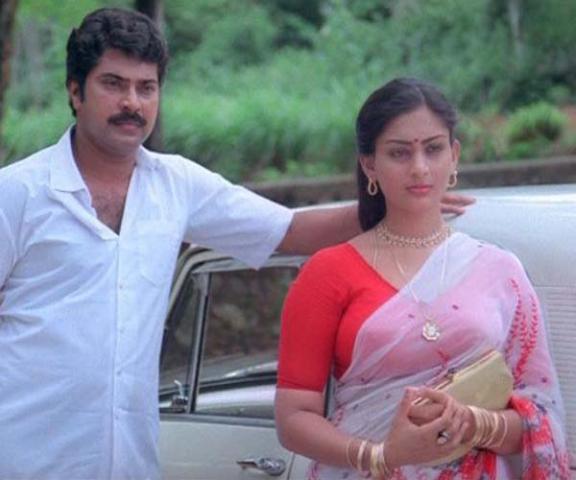
Rajan (Mammotty) is a village man who loves his cousin Ammukutty (Seema) but his stubborn father  Madhavan (Balan Nair) forces him to marry Nalini (Unni Mary). Nalini is an ambitious woman who wants to study further and achieve an educated status. Rajan on the other hand believes in simple living. They have come to a indifferent attitude to their marriage and live separate lives under one roof.


Years later when Rajan's father is bed ridden,the only person who makes time to look after him is Ammukutty. Inspite of his children only she is available and does so selflessly and without past grudges. In the midst of the ill father,property disputes and jealousies are shown as the norm of a middle class Malayali family. The old love of the two people and happier times are shown in glimpses.

I felt this movie also had a unique feature in Mohanlal's portrayal as a friend of Rajan. Not a friend who bird-watches with him or plans revenge plots. A character who expresses his love for a friend and of life. A friend who later chides him on leaving Ammukutty and questions on his morality.


Overall the movie is a drama which shows the state of thinking in a family. As it is with most, the husband expects a wife to perform and live in a certain way. Whether she is a good wife or a good mother is without meaning, if she is too ambitious. That she should be sacrificing and selfless is a norm to be accepted by most women is the message of the movie. How acceptable is the story in today's changing world maybe debatable. Nevertheless, Aalkkoottathil Thaniye was one of the few movies of that time where a woman protagonist is essayed in a strong, independent way rather than a crying, hollering, helpless waif.